
The ability of taking control of your money, is the well-educated adult.
3 Steps Take Control Your Money
-

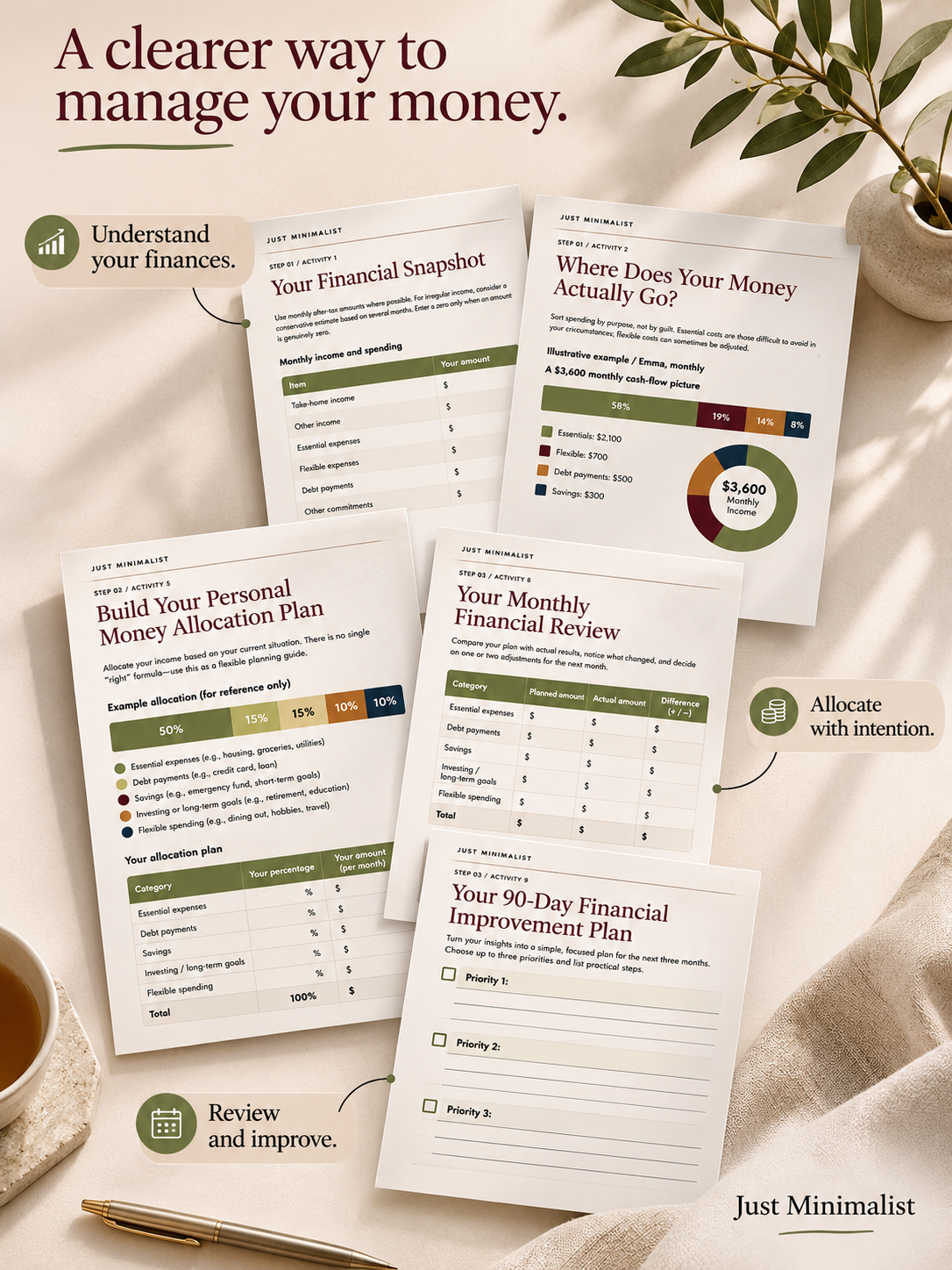
1/ Understand your circumstances
Record income, essential and flexible expenses, debt payments, savings, and assets.
Use a financial snapshot and spending chart to see how the pieces connect.
Calculate your monthly cash flow and net worth, and note three observations worth exploring.
-

2/ Rearrange and allocate
Consider your priorities and the trade-offs behind them. Rank goals and obligations, build a monthly allocation plan using your own amounts, and identify financial vulnerabilities worth preparing for.
An illustrative example shows how one person might distribute income—without presenting that distribution as a rule for you.
-

3/ Review and improve
A financial plan is not permanent.
Use a weekly check-in to notice upcoming bills and changes, compare planned and actual amounts in a monthly review, and set up to three manageable priorities for the next 90 days.
The objective is a routine you can revisit, not perfection.
Just Minimalist -
Begin with one useful step
You do not need to solve every financial question today. Start by seeing your current position. From there, choose what matters, give your money a purpose, and check in regularly.
Enter your email address to receive your free copy of Personal Money Management: A Practical Workbook for Financial Clarity.
Observe Your Money
Start by seeing your current position. From there, choose what matters, give your money a purpose, and check in regularly.
Across 18 printable US Letter pages, you will find nine guided activities, clear tables, financial charts, fictional real-life scenarios, reflection prompts, and a 90-day improvement plan. Each stage introduces the underlying idea before asking you to apply it.