#10 | What Are the Risks of Investing in Index Funds? (What Beginners Should Know)
It all begins with an idea. Maybe you want to launch a business. Maybe you want to turn a hobby into something more. Or maybe you have a creative project to share with the world. Whatever it is, the way you tell your story online can make all the difference.

A Calm, Honest Guide for First-Time Investors
Primary keyword: invest in index funds
Supporting long-tail keywords (used naturally):
risks of investing in index funds
can you lose money in index funds
are index funds safe for beginners
index fund market crash
long-term index fund risk
S&P 500 risk explained
Let’s Be Honest First
If someone tells you index funds are “risk-free,” they are oversimplifying—or selling confidence, not clarity.
Index funds are not risk-free.
But their risks are very different from what beginners usually fear.
Understanding those risks is what allows you to:
Stay invested during uncertainty
Avoid emotional mistakes
Use index funds correctly
This article exists to remove vague fear—not to scare you away.
People Also Ask: Are Index Funds Risky?
Let’s address the most common Google questions upfront.
Can you lose money in index funds?
Yes, especially in the short term.
Are index funds safe for beginners?
They are among the safest ways to invest in stocks, but still involve market risk.
What happens to index funds during a market crash?
They fall with the market—and recover with it.
Are index funds risky long term?
Historically, long-term risk is lower than most alternatives.
Now let’s break down what these risks actually look like in real life.
Risk #1: Market Risk (The One Everyone Worries About)
What it is:
Index funds rise and fall with the stock market.
If the market drops 20%, your index fund drops too.
This is not a flaw.
It’s the definition of what index funds do.
Why This Risk Feels Bigger Than It Is
Beginners often imagine market drops as:
Permanent loss
A sign they did something wrong
A reason to stop investing
In reality:
Market declines are normal
Every long-term chart includes multiple drops
Recovery is part of the system
Example: S&P 500 Market Risk Explained
The S&P 500 has experienced:
Crashes
Recessions
Political crises
Global uncertainty
And yet, over decades, it has:
Recovered repeatedly
Continued upward long-term growth
Market risk exists—but time reduces it.
Risk #2: Short-Term Loss (Timing Risk)
What it is:
You invest money and see your balance go down shortly after.
This happens more often than people expect.
Why Beginners Struggle With This
First-time investors often assume:
“If I invest correctly, I shouldn’t see losses.”
That assumption causes panic.
Index funds are long-term tools. Short-term movement is noise.
How to Reduce This Risk Practically
Don’t invest money you’ll need in the next 3–5 years
Invest monthly instead of all at once
Stop checking balances daily
This aligns directly with Topic 3: How Much Should You Invest Each Month?
Risk #3: Emotional Risk (The Most Dangerous One)
This is the risk most people don’t talk about.
Emotional risk looks like:
Panic selling during downturns
Stopping contributions when markets fall
Overreacting to headlines
Ironically, this risk comes from watching too closely.
Why Index Funds Help—but Don’t Eliminate—This Risk
Index funds reduce:
Stock-picking stress
Decision fatigue
Overconfidence
But they can’t stop you from:
Selling at the wrong time
Changing strategy repeatedly
That’s why simplicity matters.

Risk #4: Inflation Risk (If You Don’t Invest)
This is often ignored, but critical.
If your money sits in cash:
Inflation slowly erodes its value
Purchasing power declines over time
Index funds, especially broad ones like the S&P 500, historically:
Outpace inflation long term
Protect real value over decades
Not investing is also a risk.
Risk #5: Overconfidence and Overcomplication
After some success, beginners sometimes:
Add too many funds
Chase performance
Abandon their original plan
This introduces unnecessary risk.
That’s why the earlier articles emphasize:
Starting with one index fund
Often the S&P 500
Keeping the system boring
Boring is safe.
Are Index Funds Safe During a Market Crash?
This question deserves a clear answer.
During a crash:
Index fund values drop
Volatility increases
Fear becomes louder
What doesn’t change:
The companies still exist
The economy continues
Recovery historically follows
Index funds don’t protect you from crashes.
They protect you from making them worse by reacting poorly.

How Long-Term Investing Reduces Index Fund Risk
Time is the most powerful risk-management tool.
Historically:
Short-term investing = unpredictable
Long-term investing = resilient
The longer you stay invested:
The less individual downturns matter
The smoother returns become
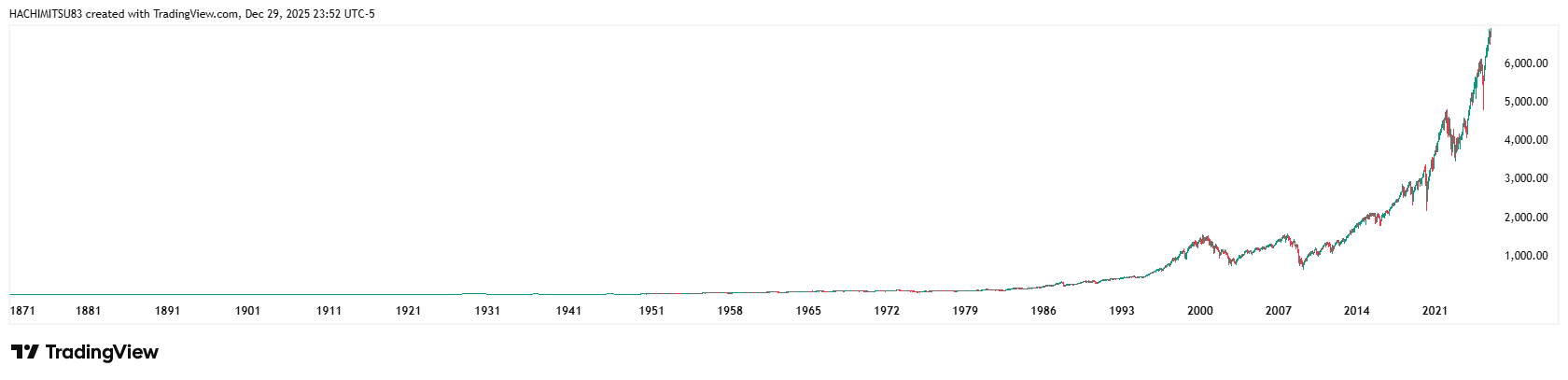
Let’s see the historical performance of S&P 500 since its lunch till today (Dec 2025). It’s wiser to focus on the long-term grwoth rather than short-term volatility.
This is why index funds are not recommended for:
Emergency savings
Short-term goals
Money you’ll need soon
The Role of the S&P 500 in Risk Management
For beginners, the S&P 500 reduces risk by:
Avoiding single-stock exposure
Spreading across industries
Reflecting the broader economy
It doesn’t remove risk—but it removes unnecessary risk.
That’s an important distinction.
Common Myths About Index Fund Risk
Myth 1: “Index funds are only safe in good economies”
False. They are built to survive bad ones.
Myth 2: “If it crashes, I lose everything”
False. Temporary decline is not total loss.
Myth 3: “I should wait until things feel stable”
Markets rarely feel stable before growth.
Final Thought: Risk Isn’t the Enemy—Confusion Is
Index funds involve risk.
So does doing nothing.
The goal isn’t to eliminate risk.
It’s to choose the kind of risk you can live with.
For first-time investors, index funds—especially starting with the S&P 500—offer:
Transparent risk
Historical context
Emotional simplicity
That’s why they work.
Unlock Your Clarity — Join Our Community Today

Any investment is contained risk, and you and minimize the risk by educate yourself and seek the current information from time to time. I’m not an expert, but here to help. Drop your questions or comments beloe and I will read all of them. Let’s expand knowledge together!