
#14 | How FED Controls Interest Rates (And What That Means for You)
Few phrases create more anxiety among new investors than “the Fed is raising interest rates.” Markets react. Headlines turn urgent. Social media fills with fear.
But interest rates are not a threat by default.
For long-term investors—especially those building wealth steadily through index funds and global assets—interest rates are a signal, not a verdict.
This guide explains how the Federal Reserve controls interest rates, why those changes happen, and—most importantly—what they actually mean for you as an investor.

How Does the Federal Reserve Control Interest Rates?
The Federal Reserve does not directly set every interest rate in the economy. Instead, it controls a key benchmark called the federal funds rate.
This rate influences:
Bank lending costs
Mortgage and loan rates
Bond yields
Valuations of stocks and ETFs
When the Fed adjusts this benchmark, the rest of the financial system follows.
The Federal Funds Rate Explained Simply
Think of the federal funds rate as:
The base price of short-term money between banks
When the Fed:
Raises rates → borrowing becomes more expensive
Cuts rates → borrowing becomes cheaper
This adjustment ripples outward, shaping consumer behavior, business investment, and asset prices.
Why Does the Fed Change Interest Rates?
The Fed changes rates to balance economic growth and inflation in the US.
When the Fed Raises Rates
Inflation is rising too fast
Economic activity is overheating
Asset speculation becomes excessive
When the Fed Lowers Rates
Economic growth slows
Unemployment rises
Credit becomes too tight
For investors, rate changes are tools for stability, not punishment.

What Happens When the Fed Raises Interest Rates?
In the short term:
Stock markets may become volatile
Growth stocks may pull back
Bond yields typically rise
Stronger currencies may emerge
In the long term:
Inflation pressure eases
Financial bubbles deflate gradually
Sustainable growth resumes
This is why reacting emotionally to rate hikes often hurts investors more than the hikes themselves.
Do Higher Interest Rates Hurt Long-Term Investors?
Short-term traders: Yes, often.
Long-term investors: Not necessarily—and sometimes the opposite.
Historically:
Markets have grown during periods of rising rates
Long-term returns depend more on consistency than timing
Rate hikes reset valuations and future return potential
For disciplined investors, rate hikes can improve future compounding, especially when investing regularly (or DCA).
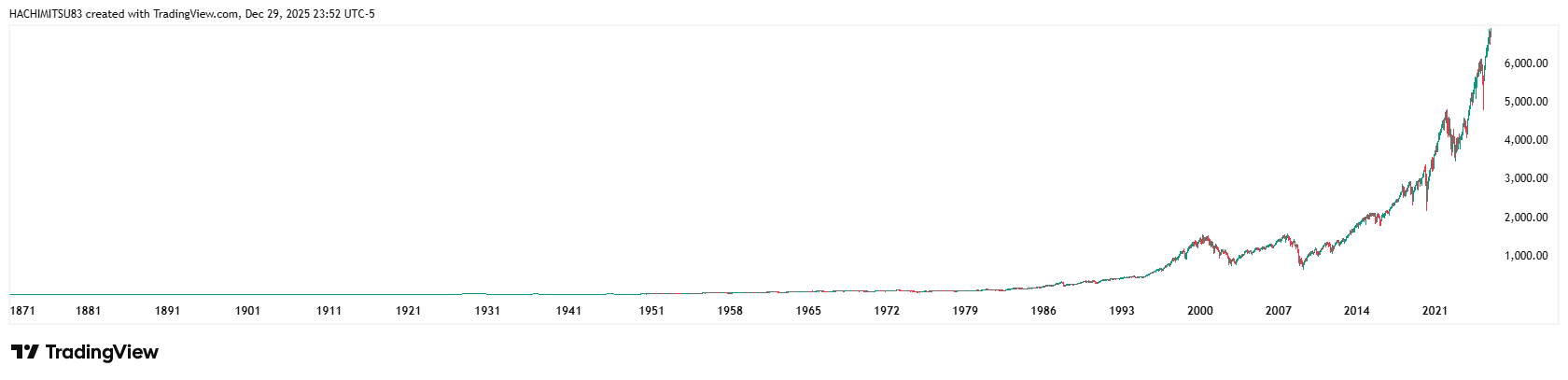
Below chart is a proof of how the US stock markets performs from time to time shown as the S&P 500 historical return over decades. This data is as of Dec 2025. So, if you’re focusing the long run, stock index investing is the best conspet to consider.
Interest Rates and Index Funds: What Beginners Should Know
Interest rate changes affect sectors differently, but diversified index funds absorb these shifts over time.
Growth-heavy indexes may fluctuate
Value and dividend sectors may benefit
Broad-market funds rebalance naturally
This is why passive investing works best when paired with patience.
Should Beginners Worry About Rate Hikes?
A simple answer is: No.
Stopping investments during rate hikes often means:
Missing lower entry prices
Breaking compounding momentum
Letting fear dictate strategy
A better approach:
Continue dollar-cost averaging
Maintain diversification
Focus on long-term goals, not headlines
Interest rates change. Your plan shouldn’t—unless your life circumstances do.
Why Markets React So Strongly to Fed Rate Decisions
Markets move not just on rate changes, but on expectations.
If a hike is expected → reaction may be muted
If guidance surprises → volatility increases
This explains why markets sometimes fall even when rates are cut, or rise during hikes.
Understanding this prevents overinterpretation of daily movements.
Interest Rates as an Environment, Not a Signal to Act
Think of interest rates like weather:
You don’t cancel life every time it rains
You adjust clothing, not direction
Successful investors adapt portfolios structurally—through diversification and time—not emotionally.
The Long-Term Investor’s Perspective on Interest Rates
Over a lifetime:
Rates rise and fall many times
Markets recover repeatedly
Compounding rewards patience
Interest rates shape how fast, not whether, wealth grows.
That’s a powerful distinction for first-time investors to internalize.
Final Thought
Interest rates are not enemies.
They are signals that guide economic balance.
When you understand how the Federal Reserve controls interest rates, you stop reacting—and start investing with confidence.
That’s how long-term growth begins.
Unlock Your Clarity — Join Our Community Today

Master your money is considered as an adult skill. Take the full control of your income, spending, and investment by leveraging knowledge from time to time.
I’m not an expert, but here to help if you’re stuggle with personal money managment. Leave your questions and comments in the comment box below. I read all messages from you, and let’s expand the world of simplicity about money together.